Salt Marsh Wildlife: Salt marshes are home to many invertebrates that feed on decomposed plant cellulose. These organisms, found most abundantly in needlerush areas, provide an important link at the base of the food chain.
- Gulf coast marshes are well known for their abundant crustaceans, gastropods and suspension feeders including fiddler crabs, grass shrimps, blue crabs, mysid shrimp and marsh periwinkle.
- The area is also home to diverse fish species, including sheepshead minnow, longnose killifish, sailfin molly, and pinfish.
- The American alligator is the only reptile with significant distribution in Gulf Coast salt marshes, but also found are the Mississippi diamondback terrapin, Alabama red-bellied turtle, and Gulf salt marsh water snake.
- Over 60 species of birds use habitats in needlerush marshes, including year-round residents such as the great blue heron and clapper rail; summer nesting birds such as least bittern; migrants including short-billed marsh wren, sedge wren, American widgeon; casual feeders such as great white heron; and summer visitors including white ibis.
- Popular mammal species in the marsh are Louisiana muskrat and marsh rabbit, while the cotton rat and rice rat live in the upland, and raccoons, mink, otter and long-tailed weasel come to the marsh to feed.
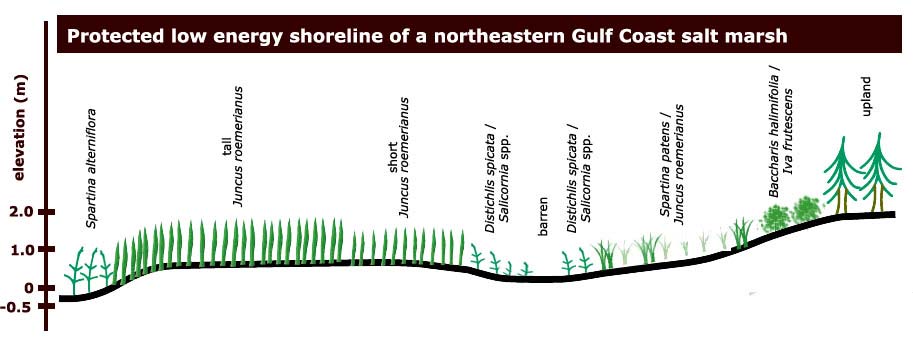
(Generalized diagram of Gulf coast salt marshes on protected low energy shorelines.)
Vegetation: Very few plants have the physical and physiological adaptations to grow and reproduce in saline areas with periodic flooding, so salt marsh vegetative species diversity is relatively low. Typically, the communities are composed of 90% grasses and grass-like plants, 5% woody plants and trees and 5% forbs. Two grass-like species play unique dominating roles:
- Smooth cordgrass (Spartina alterniflora) forms a border along open water in salt marshes. On a broad gentle slope, smooth cordgrass occupies a monospecific band 1 to 10 meters wide; greater slopes lead to mixing of smooth cordgrass and needlerush at upper elevations.
- Needlerush (Juncus roemerianus) comprises the largest vegetative zone and the bulk of the biomass in most salt marshes on the northeast Gulf Coast. Needlerush is found in a small elevation range, but can span one hundred meters to several miles wide. The entire needlerush zone is flooded very irregularly — higher elevation zones flood only in spring tides and storms.
In coastal areas with high-energy tides, needlerush and cordgrass can be found together, but more often, there is a clear separation between these zones. Other common vegetative species include: saltmeadow cordgrass, giant cordgrass, salt grass, saltworts, three-square, leafy sedge, sea lavender, arrow leaf, roseau cane, saw grass, bullwhip, and blue flag.

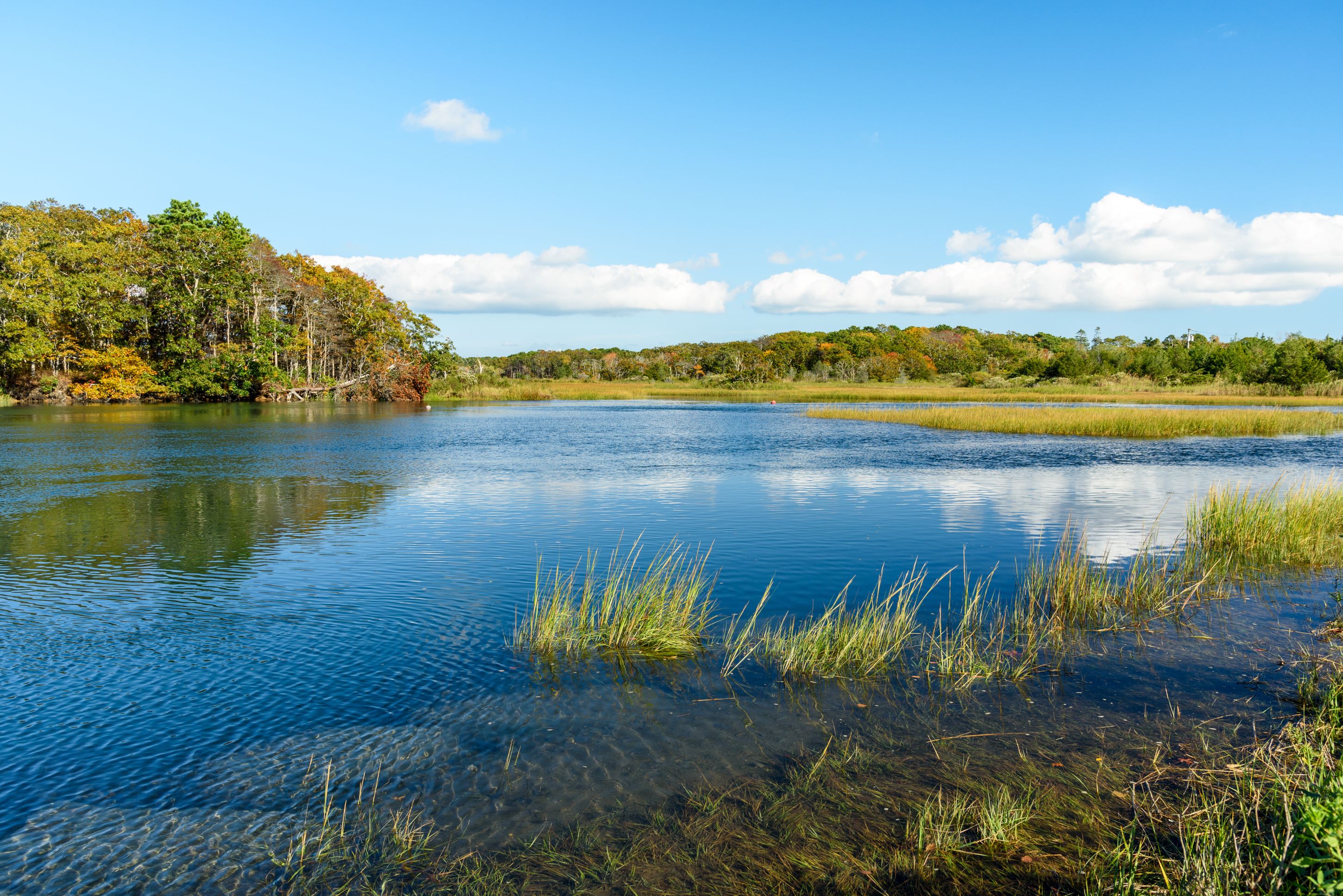
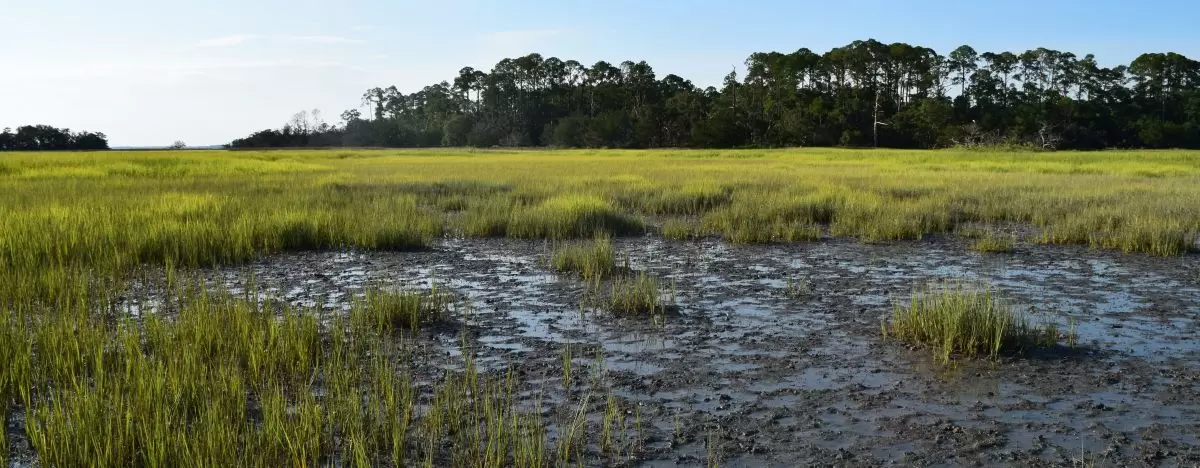 Photo Credit: Christine Angelini, https://www.nsf.gov/news/biodiversity-salt-marshes-builds-climate